



 By Milda Urban, Summersalt Yoga founder
“You should bring Croatian tourists to Myanmar and to Bagan,” says the guy next to us, on top of a hundred-year-old temple at around 5 AM after he finds out that we run a travel agency back home. We met him on our way to watch the sunrise, speeding off the dusty “roads” in Bagan, still dark, quite chilly, anticipation high, and eyes full of sand. Yes, that’s Myanmar travel.
The young man saw our uncertain looks pointed at Google Maps a few minutes ago when we were trying to find the Shwesandaw Pagoda. He stopped his motor to ask what we were looking for. Shwesandaw, we said. “Follow me, I know a better place, no people,” he signaled.
We arrive at a small pagoda, which, according to our new friend, is a much better spot to watch the sunrise with no crowds. As proof, he even shows us some photos on his phone. He waves us to remove our shoes and follow through a dark passage to climb up. I hesitate—we’re stomping this ancient pagoda to catch the sun—is this okay? But hey, I guess some monks back in the day did the same.
On Top of the World
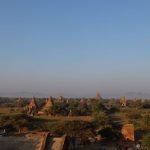
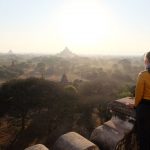
We reach the top, sit down, and our new friend joins us. We stare at the vast space, the mushroom-like pagodas, and wait for the sun. Our friend says he’s an artist, but still a student. We say we love Myanmar and travel. The light starts to rise, and so do the air balloons with champagne-sipping tourists.
Only a couple more people find our pagoda, so we’re not bothered by the usual commotion. We’re silent and take only a few photos. After some time, we step down and our friend shows us some of his paintings—pagodas, Buddhist monks, Bagan landscapes. After some bargaining, we buy one.
Unexpected Kindness in Myanmar Travel
You might say he did it to make a sale. I get it. That’s how our Western mind works. But when we offered tip money, he refused, saying he doesn’t take “lucky money” as it’s not in the Buddhist faith. He sells paintings to support his family, but “because we’re friends now,” he understands if we don’t buy anything.
He didn’t have to help us, guide us, chat with us. He did. That’s what Myanmar is to me: kindness.
First Impressions of Bagan
We flew into Bagan from Yangon the day before. The landing was jaw-dropping—seeing the pagodas felt like landing on Mars. An old, rusty bus took us to the terminal in under a minute. We got our luggage quickly. Like a scene from Indiana Jones.
By 8 AM, we were in Nyaung-U and watched baby monks (maybe 7 or 8 years old) collecting rice donations. It was cheesy, innocent, adorable—we couldn’t get over it for the rest of the day.
A Lesson in Local Transport
In the afternoon, we skipped renting electric bikes (the main tourist transportation) and opted for a cab. Big mistake. Walking around Old Bagan, we couldn’t find a cab back. Horse-carriage drivers laughed at our low offers. We ended up walking to the main road.
There, a boy (maybe 13) with a huge smile appeared. “Where you go?” he asked. We told him our village. “Car!” he smiled and started hitchhiking for us. No one stopped, but he wasn’t discouraged. Eventually, he flagged down a motorbike and asked it to take us. I declined politely. We decided to head back to town. The boy nodded and vanished, just like he came.
The Charm of Bagan’s Pagodas
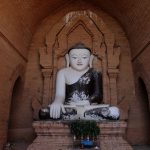
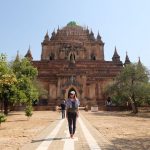
Bagan is 12 centuries old with over 2,200 remaining pagodas from the original 10,000. Over 400 earthquakes struck Myanmar in the 20th century, and a major one in 2016 damaged 33 temples. Many argue it deserves UNESCO heritage status, but ongoing restorations have hindered that.
Exploring on electric bikes felt like a safari—but instead of animals, you spot ancient pagodas at every turn. We did encounter some touristy moments (“very cheap, I give you discount”), but far less than in other regions.
Humor and Local Color
We bought a postcard from a boy collecting foreign currency. When we didn’t buy from his friend, we got a cheeky “no money, no honey.” Most pagodas were quiet. At best, you’re offered a cold coconut, a Coke, or Orwell’s “Burmese Days.”
The dusty roads, the temples, the occasional buffalo roadblock—everything felt like a movie. Watching the sunset from the Bulethi pagoda was a highlight, though it was packed. I spent more time annoyed by the photo-hungry crowd than actually watching the sunset. Snobbish? Maybe. Still true.
A Quirky Bus Ride Back to Yangon
To save money, we took a 10-hour bus back to Yangon. We were the only foreigners. Locals smiled, stared, giggled—especially when we tried tying a longyi.
We eventually understood the red vampire smiles and frequent spitting—betel chewing. It’s a beloved local custom. Betel leaves are sold everywhere, often wrapped with spices. Even buses hand out spitting bags. After 8 hours of it, I skipped dinner.
Exploring Yangon: A Myanmar Travel Highlight
Yangon feels like a James Bond movie. It’s gritty, energetic, and unlike any other Southeast Asian city. It hasn’t been fully shaped by Western influence, and that’s its magic.
From street food aromas, longyis, Thanaka makeup, to crumbling colonial architecture—it all forms a unique visual and cultural tapestry. The food scene is incredible: mohinga, Burmese biryani, tea leaf salad, curries, and Indian-inspired street food.
Local Life and Cultural Pride
Yangon’s locals enjoy their street cafes and conversations. Despite its poverty (Myanmar ranks low on the Human Development Index), the street life is vibrant and social.
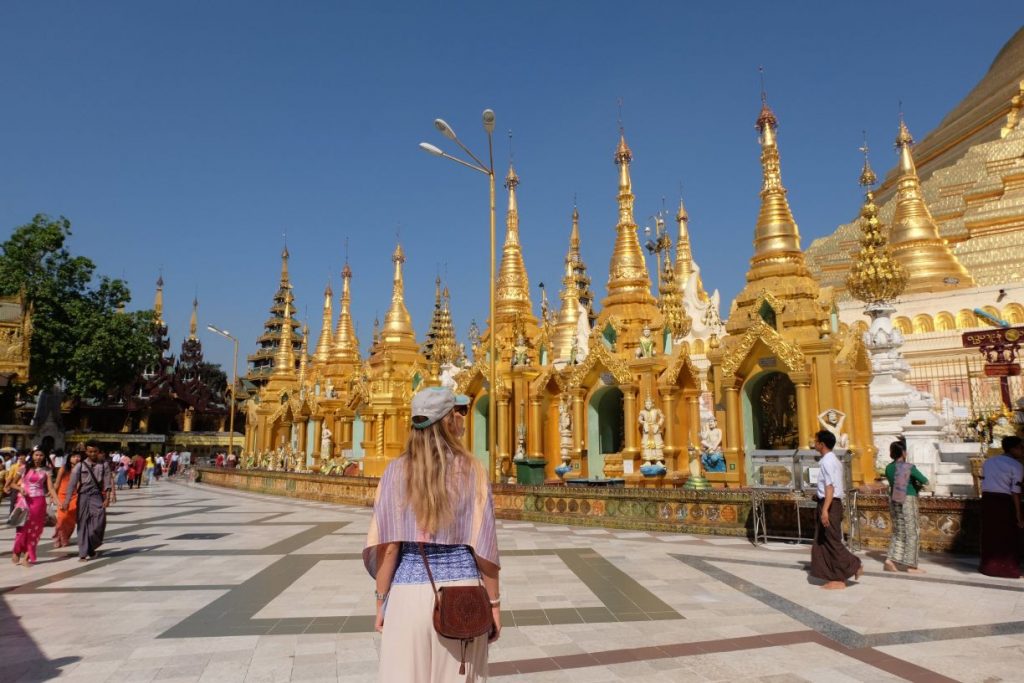
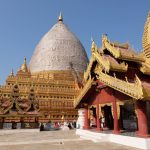
Don’t miss the Shwedagon Pagoda—99 meters tall and gold-plated with diamonds. Or the National Museum, where you can explore Myanmar’s complex history, and the Gem Museum for its world-famous rubies and jade.
Goodbye Myanmar, For Now
At the airport, I’m eating a blueberry croissant, heading to Vietnam. I scroll through photos, still in disbelief. I ask the waiter to exchange my leftover kyat for smaller notes to keep as souvenirs. I have a feeling I’ll need them again soon.
I promise, Myanmar.
This article has appeared in the newspaper “Verslo Zinios” first (in Lithuanian language) in 2017.



 © Copyright Dalmatia Events |